
The life of a student in 2026 is a constant tug-of-war between academic ambition and digital distraction. We are the first generation to carry the entirety of human knowledge—and the entirety of human entertainment—in our pockets at all times. While the internet has made research faster, it has also made the act of sitting down to write a 3,000-word essay feel like an impossible task. If you’ve ever found yourself staring at a blinking cursor for an hour while your phone buzzed with “urgent” notifications, you know that the problem isn’t a lack of time; it’s a lack of focused attention.
Adopting a philosophy of digital minimalism is the only way to survive the modern educational landscape. Minimalism isn’t about being “anti-tech”; it is about being “pro-intention.” It is the practice of ruthlessly eliminating any digital tool that does not add massive value to your life. For a student, this means creating a digital fortress that allows for deep, uninterrupted thought. Whether you are navigating complex research or seeking Assignment Help Australia through the experts at MyAssignmentHelp, the goal is to create a workflow that is streamlined, efficient, and free from the mental “friction” caused by digital clutter.
The Psychological Toll of Digital Noise
Before we dive into the tools, we have to understand why we need them. Every time you shift your attention from your textbook to a WhatsApp message, your brain experiences a phenomenon known as “attention residue.” It takes your mind an average of 23 minutes to fully refocus on a complex task after a single interruption. If you check your phone every ten minutes, your brain never actually reaches the “Deep Work” state required for high-level academic performance.
This is why so many students feel exhausted even when they haven’t “done” much work. Your brain is tired from the constant switching. By using minimalist tools, you aren’t just saving time; you are saving your cognitive energy. This energy is what you need for the heavy lifting of university life: analyzing data, synthesizing arguments, and eventually crushing academic deadlines with confidence rather than panic.
1. Freedom: Reclaiming Your Digital Autonomy
The first tool on our list is perhaps the most powerful “blocker” ever created. Freedom is based on the simple premise that willpower is a finite resource. You only have a certain amount of self-control each day, and if you spend it all trying not to check TikTok, you won’t have any left to finish your lab report.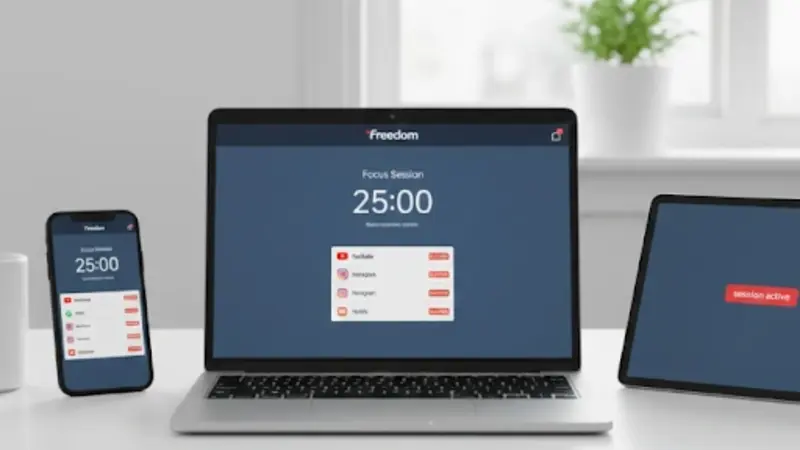
Freedom allows you to create “Blocklists” that sync across your entire ecosystem. If you block “Social Media” on your MacBook, it is automatically blocked on your iPhone and iPad as well. This is crucial because many students try to cheat their own systems by putting their phone away, but then opening “distraction sites” in a new browser tab.
How to use it for Academic Success:
To get the most out of Freedom, schedule “Focus Sessions” in advance. For example, set a recurring block from 9:00 AM to 12:00 PM every weekday. During this time, the internet—or at least the distracting parts of it—simply doesn’t exist for you. This creates a ritual. Your brain begins to recognize that when the “Freedom” logo is active, it is time for serious work.
2. Forest: The Art of Visual Accountability
While Freedom acts as a “shield,” Forest acts as a “motivator.” It is a gamified timer that taps into our natural desire to protect and nurture. When you want to focus, you plant a virtual tree. If you leave the app to check a message or browse the web before the timer is up, your tree dies.
For many students, the “pain” of seeing a withered, brown tree in their digital forest is enough to keep them off their phones. It turns the abstract concept of “time management” into a visual, tangible experience.
Why Minimalism Loves Forest:
It follows the minimalist principle of “One Task at a Time.” In an era of multi-tasking, Forest forces you to commit to a single block of time. If you can grow a forest of 40 trees in a week, you have proof of your productivity. This visual feedback loop is incredibly satisfying and helps reduce the anxiety that often comes with heavy workloads.
3. Notion: Eliminating the “Search” Fatigue
Minimalism is as much about organization as it is about restriction. Notion has become the gold standard for students because it replaces five different apps. Instead of having a calendar app, a note-taking app, a to-do list, and a file-storage app, you have one “Second Brain.”
The “Minimalist” way to use Notion is to keep your dashboard clean. Use a “Master Task Database” to track every single assignment for the semester. When you know exactly what is due and when, you eliminate the “background noise” of worry that plagues most students. You no longer have to wonder, “Am I forgetting something?” because Notion holds all the answers.
The Power of Templates:
You can build templates for specific study types. For instance, a “Literature Review” template can help you organize your sources so that when it comes time to write, the information is already at your fingertips. This level of organization is what separates students who struggle from those who excel.
4. Minimalist Phone: Breaking the Dopamine Loop
Your smartphone is a slot machine. The bright colours, the red notification bubbles, and the infinite scrolling are all designed to keep your attention on the screen. To truly focus, you need to change the hardware-software relationship. Minimalist Phone is a “launcher” for Android (with a similar version, “Dumbphone,” for iOS) that removes all visual cues.
Your home screen becomes a simple list of words. No icons. No colours. No distractions. This is a game-changer for students who find themselves “reflexively” tapping on apps. When the icon isn’t there, the craving to click often disappears.
If you are currently struggling with a complex project and need Programming Assignment Help, you might find that your biggest hurdle isn’t the code itself, but the fact that your phone is constantly pulling you away from the “logic flow” required for programming. Above the 4th heading in your study plan, make “Switch to Monochrome Mode” a top priority. When your phone looks boring, your brain will naturally look for stimulation elsewhere—usually in the task you are supposed to be doing.
5. Cold Turkey: The “Nuclear Option” for Procrastination
If you have tried everything and still cannot meet your goals, it’s time for Cold Turkey. This tool is for a student with a 5,000-word dissertation due in three days who hasn’t started yet.
Cold Turkey is “hard” to circumvent. You can’t simply turn it off in Task Manager or uninstall it while a block is active. It even includes a feature called “Frozen Turkey” that can lock you out of your entire computer, allowing you to use only a specific word processor.
The “Writer” Feature:
This is the hidden gem for students. It turns your computer into a digital typewriter. You can set a goal—say, 1,000 words—and Cold Turkey will not let you leave the application until you have typed those 1,000 words. It is the ultimate tool for “crushing” through the resistance of the first draft.
The Strategic Synergy: Putting it All Together
Using one of these tools is helpful, but using them as a system is transformative. Imagine a typical Tuesday:
- Your Minimalist Phone keeps you from scrolling in bed.
- You sit down at 9:00 AM, and Freedom automatically blocks the web.
- You open Notion to see your pre-planned tasks.
- You plant a tree in the forest to start your first 50-minute “sprint.”
- If you get stuck, you use Cold Turkey to force the writing out.
This is how high-achievers operate. They don’t have more willpower than you; they just have better systems. They understand that the environment often trumps intentions, so they design an environment where success is the only option.
Why Quality Matters More Than Quantity
In the world of digital minimalism, we emphasize “High-Quality Leisure” and “High-Quality Work.” When you are working, work hard. Use every tool at your disposal to be efficient. And when you are done, be done. Close the laptop, put the phone in another room, and actually live your life.
The paradox of minimalism is that by doing “less” (fewer apps, fewer distractions, fewer tabs), you actually achieve much more. You’ll find that you finish your assignments faster, the quality of your research improves, and your stress levels plummet.
A Final Word on Academic Support
Even with the best tools in the world, university life can occasionally become overwhelming. Sometimes, the sheer volume of work or the complexity of a subject is more than one person can handle alone. In these instances, the minimalist approach is to “delegate” effectively.
Professional services like myassignmenthelp are designed to be part of a student’s support system, providing the research and structural guidance needed to move forward when a student hits a wall. Using a service like this isn’t a sign of failure; it’s a strategic move to ensure that your academic record remains spotless while you master the material at your own pace. If you want to read more, please visit our website.
Frequently Asked Questions
What is the core principle of digital minimalism for students?
It is the practice of intentionally selecting a small set of digital tools that support your educational goals while removing distractions that add no value to your learning.
Can these tools work for students with different learning styles?
Yes. Whether you are a visual learner who benefits from gamified timers or a logical thinker who needs structured organization, these tools are highly customizable to fit various academic workflows.
How long does it take to see results from a digital detox?
Many students report a significant increase in concentration and a reduction in stress within the first 48 hours of limiting their screen time and silencing non-essential notifications.
Is it necessary to use all five tools simultaneously?
Not at all. The best approach is to start with one tool that addresses your biggest challenge—such as website blocking or note organization—and gradually build a system that works for you.
About The Author:
Min Seow is a dedicated academic strategist and lead contributor at myassignmenthelp. With a focus on student productivity and educational technology, Min specializes in developing workflows that help learners navigate the complexities of modern university life with clarity and ease.